

The Fiber
Rare by nature.
Baby alpaca is not a baby animal. It's a fiber classification — 19 to 22 microns in diameter, among the finest natural fibers used in knitwear. The name refers to fineness, not age.

THE FIBER
Finer than most cashmere
Baby alpaca fiber measures 19–22 microns. Standard cashmere runs 15–19 microns but in much shorter staple lengths, which shortens garment life and increases pilling. Alpaca fiber grows longer, giving it more structural strength per strand.

Naturally hypoallergenic
Alpaca fiber is naturally hypoallergenic. Unlike sheep's wool, it contains no lanolin — the common allergen responsible for the itch and irritation many people associate with wool — which is why it's worn comfortably against skin, including by people who find wool itchy.

Warmer, lighter
Alpaca fiber is hollow at the core. That structure traps air, giving it a higher warmth-to-weight ratio than most sheep's wool — warmer garments without added bulk.

Bred for altitude, not for land
Alpacas graze at 3,500–5,000 meters in the Peruvian Andes, on land unsuited to most other agriculture or livestock. Unlike cashmere goats, linked to grassland degradation in Mongolia and China, alpaca grazing has coexisted with the same ecosystem for over 6,000 years.

A natural spectrum, undyed
Alpacas grow fiber in over 20 natural colors — from ivory and beige to fawn, brown, gray, and black — the widest natural color range of any fiber-bearing animal. This reduces, and in many cases eliminates, the need for chemical dyeing.

Traced, not assumed
Our fiber comes from Amano, sourced through the Pacomarca and Inca Tops programs in Peru. Every batch is traceable back to source — including Eco Puna Black, which accounts for 0.07% of global alpaca fiber production through the YanaPaco breeding program.

Traced, not assumed
Shop the collection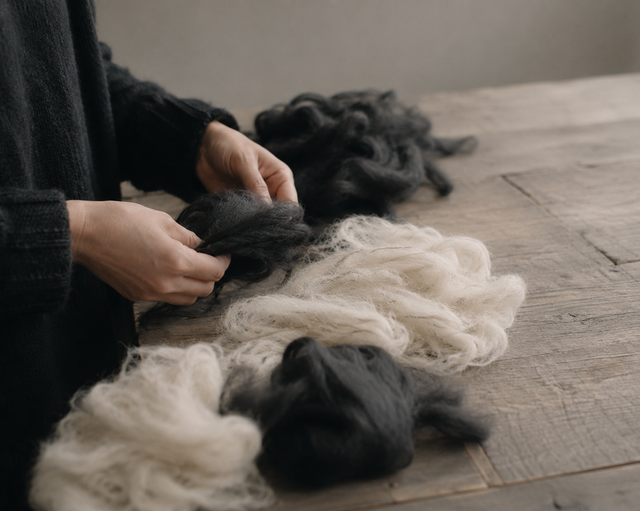
Our fiber comes from Amano, sourced through the Pacomarca and Inca Tops programs in Peru. Every batch is traceable back to source — including Eco Puna Black, which accounts for 0.07% of global alpaca fiber production through the YanaPaco breeding program.
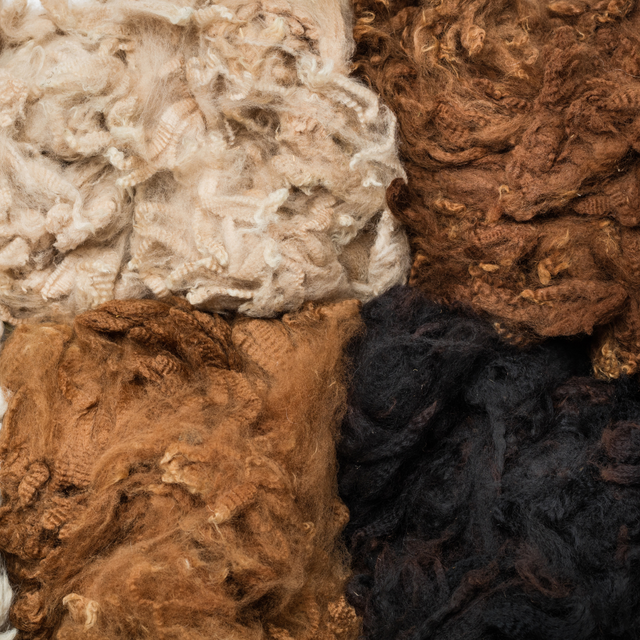
Raw fiber, before it becomes a garment
Fiber, traced to its origin
At The Knitter Club, each garment starts as raw alpaca fleece from the Peruvian Andes — the kind you see here, unprocessed and undyed.
From there, it's spun, hand-knitted in small batches in Lima, and linked to the artisan who made it.
We don't produce on demand. Pieces are made in limited runs and held as ready stock, so what you see is what's available.
Small variations between garments are part of their handmade nature, not a flaw.
Where it's made
The Workshop
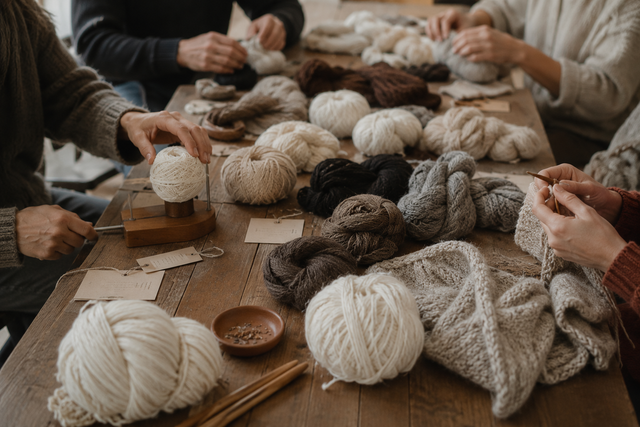
The Knitter Club is knitted by hand in a small workshop in Lima. A group of knitters works together there — winding yarn, sorting fiber, finishing each piece by hand.
Every garment is knitted individually and linked to the person who made it. We keep that record — not published, but traceable, should you ever want to know. No two pieces are ever exactly alike.